If your garage door made a loud bang, only opens a few inches, feels too heavy to lift, or left a car trapped inside, the spring is likely broken. Stop using the opener and call for service. A broken spring turns the door into dead weight, and forcing it can damage panels, cables, track, and the opener.
GarageGuard repairs broken torsion and extension springs across New York, New Jersey, and Fairfield County CT, with same-day service when scheduling and parts availability allow. We diagnose the full lift system first, match the spring to the actual door, balance the door by hand, and test the opener only after the door is safe to run again.
What a broken spring looks and sounds like
Spring failures often look like opener problems. The motor may hum. The trolley may move a few inches and stop. The door may reverse immediately or sit crooked because one side has lost cable tension. The clue is usually weight: the door suddenly becomes too heavy for the opener or too heavy to lift safely by hand.
Common signs include:
- a loud bang from the garage,
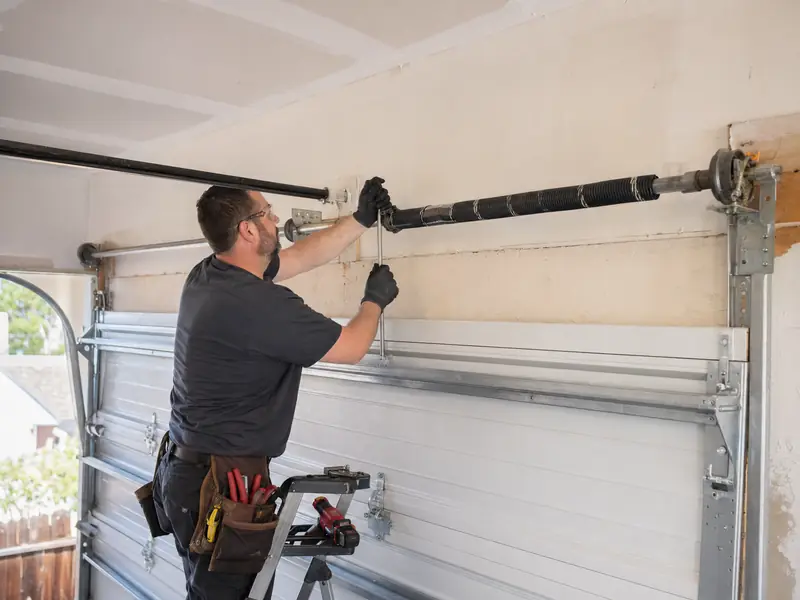
- a visible gap in the torsion spring above the door,
- a stretched or separated extension spring along the side track,
- the door rising only a few inches,
- one side sitting lower than the other,
- loose or uneven cables on the drums,
- an opener that strains, clicks, hums, or stops,
- a door that falls quickly when lowered.
If any of those are happening, do not keep cycling the opener. Continued force can turn a spring job into an off-track repair, cable repair, panel replacement, or opener replacement.
Torsion springs vs. extension springs
Most newer residential doors use torsion springs mounted on a shaft above the door opening. Older or lighter setups may use extension springs running along both horizontal tracks. Both systems store heavy tension and both need the correct spring size for the door.
The right replacement depends on door height, door weight, spring diameter, wire size, length, lift cable setup, track configuration, and how often the door is used. Installing a spring that is too weak leaves the opener overloaded. Installing a spring that is too strong can make the door fly up, lose tension, or behave unpredictably.
GarageGuard checks the door system before replacement so the repair is matched to the door, not guessed from the broken part alone.
Why this is not a DIY repair
Garage door springs are under enough stored tension to cause serious injury. The danger is not just the spring itself. A loose cable can whip, a winding bar can slip, a bottom fixture can release, and a heavy door can drop without warning.
A safe repair requires more than changing the spring. We inspect:
- cables and drum wrap,
- rollers and hinges,
- bottom brackets and bearing plates,
- spring shaft, cones, and center bearing,
- track alignment and panel condition,
- opener rail, force, travel, and safety reverse,
- whether the door balances before the opener is reconnected.
That system check protects the opener and helps prevent a repeat failure after the new spring is installed.
What to tell us when you call
A few details help us route the right technician and likely parts. Tell GarageGuard:
- your town or neighborhood,
- whether the door is stuck open, closed, or partly open,
- whether a vehicle is trapped inside,
- whether you heard a bang,
- whether you see a gap in the spring,
- whether cables are loose or uneven,
- the approximate door size if you know it,
- the opener brand if the motor is also acting up.
If you can take a photo safely from inside or outside the garage, send the spring area, both bottom corners, and the opener rail. Do not stand under a damaged door or try to lift it for a photo.
Same-day local spring repair
A broken spring is one of the most urgent garage door repairs because it can block a car, expose the garage, or leave the door too heavy to secure. GarageGuard handles spring repair across Nassau, Suffolk, Queens, Brooklyn, Staten Island, Westchester, Northern New Jersey, and Fairfield County CT.
For stuck-open doors, the priority is securing the opening safely. For stuck-closed doors with a trapped car, the priority is restoring safe lift without damaging the opener. In both cases, we explain the diagnosis and quote the repair before work starts.
What happens after replacement
After the new spring is installed, the door should lift smoothly by hand, hold balance near the halfway point, travel squarely, and let the opener move it without strain. We cycle-test the system, watch cable wrap on the drums, check safety reverse, and confirm the door is not masking another issue such as worn rollers or bent track.
If related parts are worn, we separate urgent safety items from optional maintenance so you can make a clear decision.
Related services
- If the broken spring left the door crooked or jammed, see off-track garage door repair.
- If the cable slipped, frayed, or came loose when the spring failed, see cable and roller repair.
- If the opener still hums, clicks, reverses, or strains after the door is balanced, see garage door opener repair.
- If a damaged section or impact caused the system to bind, see garage door panel replacement.
- For urgent stuck-open or trapped-car situations, see emergency garage door repair.
- To reduce future wear, schedule garage door tune-up and maintenance.