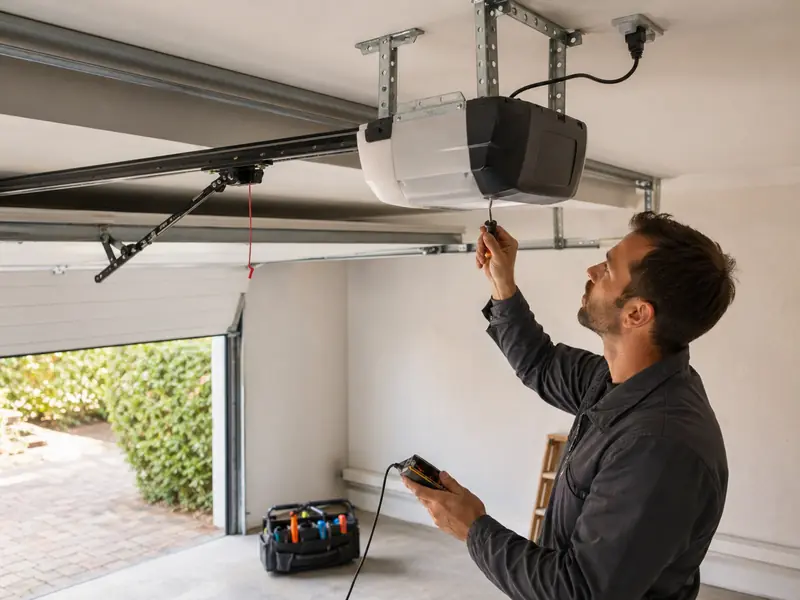
A garage door opener that hums, clicks, reverses, or stops responding is usually fixable, but the opener is not always the real problem. Broken springs, snapped cables, tight rollers, bent tracks, and an unbalanced door can all make a good opener look like it failed.
GarageGuard repairs and replaces garage door openers across New York, New Jersey, and Fairfield County CT, including LiftMaster, Chamberlain, Genie, Craftsman, Raynor, Marantec, and Linear systems. Same-day opener repair is available when scheduling and parts availability allow.
If the door is heavy, crooked, stuck halfway, or the opener strains badly, stop using it until the door is checked. Continuing to run the opener against a bad spring, cable, or track can burn out the motor or damage the door.
What usually happened
Most opener calls fall into one of a few patterns:
- the safety sensors are blocked, dirty, misaligned, or failing,
- the travel limits or force settings are wrong,
- the gear, capacitor, belt, chain, trolley, or rail is worn,
- the remote, keypad, wall console, HomeLink, or Wi-Fi connection lost programming,
- the door is too heavy because of a spring, cable, roller, or balance problem,
- the opener is old enough that replacement is safer than another repair.
The first step is always to separate door trouble from opener trouble. A balanced garage door should lift smoothly by hand when disconnected from the opener. If it does not, repairing the opener alone will not solve the real issue.
Repair vs. replace
We do not push replacements when a repair will do the job. If a capacitor, sensor, gear set, remote, keypad, belt, chain, or logic board is the problem, we will explain the repair and cost before starting.
Replacement usually makes more sense when the opener is old, very noisy, repeatedly losing settings, missing modern safety features, or failing in more than one place. A new opener can also be the better call if you want quieter operation, battery backup, Wi-Fi/app control, or a fresh warranty.
Brand-specific opener checks
LiftMaster and Chamberlain openers often share myQ smart-control behavior, photo-eye safety logic, and compatible remote/keypad programming paths. Genie and Craftsman systems have their own learn-button and safety-sensor patterns. We check the brand, model, indicator lights, error flashes, drive type, and door balance before quoting repair or replacement.
For app-connected openers, we test the physical door first, then the wall control, remotes, keypad, Wi-Fi pairing, and app response. That keeps a simple network or programming issue from being confused with a bad motor.
Smart opener integration
If you are replacing an older unit, it is often worth upgrading to a quieter Wi-Fi-enabled opener. Smart openers can show whether the door is open or closed, send alerts, and let you control access from your phone.
GarageGuard can install compatible smart openers, program remotes and keypads, connect supported apps, and confirm the door opens, closes, reverses, and reconnects correctly before the job is done.
Proof and trust signals
For opener work, the quality check is simple: the door should move smoothly, reverse safely, respond to the controls you actually use, and stop straining the motor. GarageGuard’s public reviews across Google, Thumbtack, and Angi repeatedly mention fast response, clear explanations, and repairs completed without unnecessary upsells.
Related services
- If the opener strains because the door feels heavy, see garage door spring repair.
- If the door is crooked, jammed, or rubbing the track, see off-track garage door repair.
- If the opener issue started after a snapped cable or roller problem, see cable and roller repair.
- For urgent stuck-door situations, see emergency garage door repair.