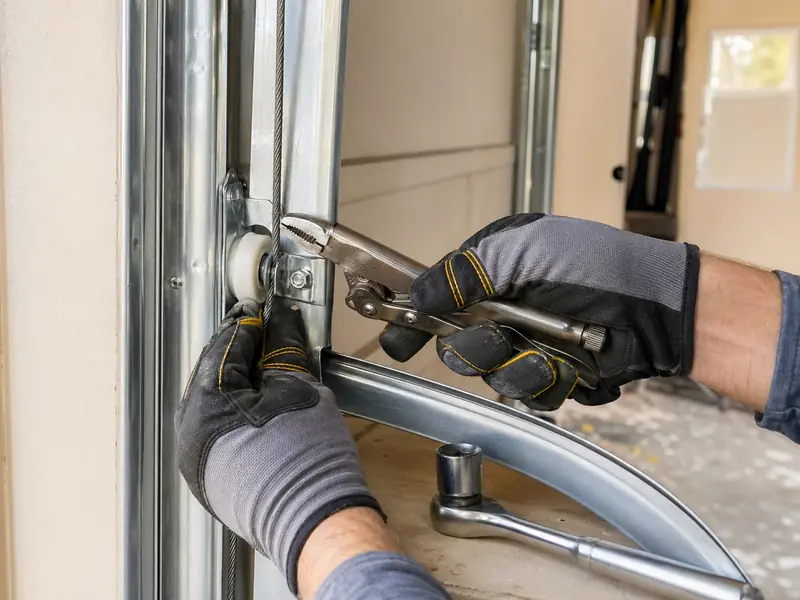
Lift cables and rollers are small parts doing heavy work. Cables carry the door’s weight from the spring system to the bottom fixtures, while rollers guide every section through the track. When either one wears out, the door can tilt, bind, scrape, drop, or come off-track.
GarageGuard repairs frayed cables, slipped cables, noisy rollers, cracked rollers, and crooked doors across New York, New Jersey, and Fairfield County CT, with same-day service when scheduling and parts availability allow. If a cable is hanging loose or the door is leaning to one side, stop using the opener and call before the failure turns into a larger off-track or panel repair.
What cable and roller problems look like
Cable and roller failures often start quietly. A door may scrape at one side, pop while moving, shake near the top of travel, or need the opener to pull harder than usual. Those are warning signs that the door is no longer moving evenly.
Common patterns include:
- frayed cable strands near the bottom bracket or drum,
- a cable wrapped unevenly around the drum,
- one side of the door sitting lower than the other,
- rollers wobbling, cracking, flattening, or dragging,
- a grinding sound from the vertical track,
- a door that starts straight but binds halfway,
- an opener that strains because the door is not rolling freely.
Do not cut, unwind, or tug on a garage door cable. The cable is tied into the spring system and can move suddenly under tension.
Why we inspect more than the visible cable
A cable can fail because it reached the end of its life, but it can also be damaged by another problem. A weak spring can change cable tension. A bent track can force rollers sideways. A loose hinge can pull the section crooked. A worn bottom fixture can make the cable angle unsafe.
GarageGuard checks the full lift and guide system before replacing parts:
- cable condition and drum wrap,
- bottom brackets and fixtures,
- rollers, hinges, and track alignment,
- spring balance and door weight,
- panel condition and section alignment,
- opener force, travel, and safety reverse.
That system check helps prevent a temporary fix where the new cable or roller is damaged again by the same underlying issue.
Cable replacement: why matched pairs matter
Replacing one visibly broken cable can look like the cheapest option, but both cables have usually gone through the same number of cycles. If one cable is frayed or kinked, the other may be close behind.
Matched-pair replacement keeps tension even, reduces crooked travel, and lowers the chance of a second service call for the opposite side. After replacement, the door should lift squarely, cable wrap should stay even on both drums, and the opener should guide the door without fighting it.
Roller replacement: quiet travel and off-track prevention
Bad rollers make the door noisy and can also push it out of alignment. A roller that wobbles, binds, or jumps can make the door scrape the track and increase strain on hinges, cables, springs, and the opener.
For most residential doors, quiet nylon rollers are a practical upgrade. Heavier or specialty doors may need different roller hardware. We match the roller to the door weight, track condition, and daily use pattern, then cycle-test the door so it travels cleanly.
What to tell us when you call
A few details help us route the right technician and parts. Tell GarageGuard:
- your town or neighborhood,
- whether the door is open, closed, or stuck halfway,
- whether a cable is hanging, loose, or wrapped unevenly,
- whether the door looks crooked or one side is lower,
- whether the noise is scraping, grinding, popping, or banging,
- whether the opener still runs or only hums,
- whether the door was recently hit or forced.
If you can take photos safely, send the cable/drum area, both bottom corners, and the side track. Do not stand under a damaged door or move the door for a photo.
Same-day local cable and roller repair
Cable and roller failures can quickly become security and access problems when a door is stuck open, a car is trapped, or the door cannot close squarely. GarageGuard handles cable and roller repair across Nassau, Suffolk, Queens, Brooklyn, Staten Island, Westchester, Northern New Jersey, and Fairfield County CT.
For stuck-open doors, the priority is securing the garage without forcing the opener. For crooked doors, the priority is restoring even cable tension and roller travel before the door bends panels or jumps the track.
Related services
- If the cable slipped after a loud bang or heavy door, see garage door spring repair.
- If the door is already crooked, jammed, or out of the rail, see off-track garage door repair.
- If the opener strained while the door was binding, see garage door opener repair.
- If the door section is bent from impact or uneven travel, see garage door panel replacement.
- For urgent stuck-open or trapped-car situations, see emergency garage door repair.
- To catch cable and roller wear early, schedule garage door tune-up and maintenance.