A new garage door is a high-visibility home upgrade and a safety decision. The right replacement should fit the opening cleanly, lift smoothly, seal well, match the house, and avoid overworking the opener. GarageGuard installs residential garage doors across New York, New Jersey, and Fairfield County CT, including insulated replacement doors, new hardware, opener setup, old-door removal, and final safety testing.
If your current door is bent, rotted, rusted through, repeatedly coming off track, or too heavy for the opener, replacement may be safer than another repair. If the damage is isolated, we will say so and explain whether panel replacement, spring repair, opener repair, or a full installation is the smarter path.
When replacement is the better call
Repair is often the right answer for a single failed part. Full installation starts to make more sense when the door is no longer structurally reliable or when multiple systems are failing at once. Common replacement triggers include:
- impact damage from a vehicle or storm,
- panels that are cracked, bowed, rusted, rotted, or separating,
- repeated off-track problems caused by a weak or distorted door,
- a heavy uninsulated door that strains the opener,
- drafts, water intrusion, damaged bottom seal, or poor garage comfort,
- an outdated exterior that hurts curb appeal or resale presentation,
- a door style that no longer matches the home after exterior updates.
The goal is not to sell a new door when a repair will work. The goal is to prevent repeated service calls on a door that has reached the end of its useful life.
How we help choose the right door
A replacement door should be selected for the house, not just the brochure photo. We look at the opening size, track layout, headroom, side room, driveway slope, weather exposure, attached-garage comfort, and the door’s relationship to the front elevation.
For many NY, NJ, and Fairfield County homes, insulated steel gives the best balance of durability, style flexibility, noise reduction, and maintenance. Carriage-house, contemporary flush, raised-panel, windowed, wood-look, aluminum, and glass options can also work well depending on architecture and budget priorities.
If the garage sits under a bedroom, beside a living space, or doubles as a workshop, gym, mudroom, or storage area, insulation and perimeter sealing matter more. If curb appeal is the primary driver, panel design, window pattern, color, and decorative hardware may matter most.
What a proper installation includes
A new garage door installation is more than swapping panels. The new door weight has to match the spring system, track, rollers, cables, hinges, opener force settings, and safety reversal behavior. Poor setup can make a new door noisy, unsafe, or hard on the opener.
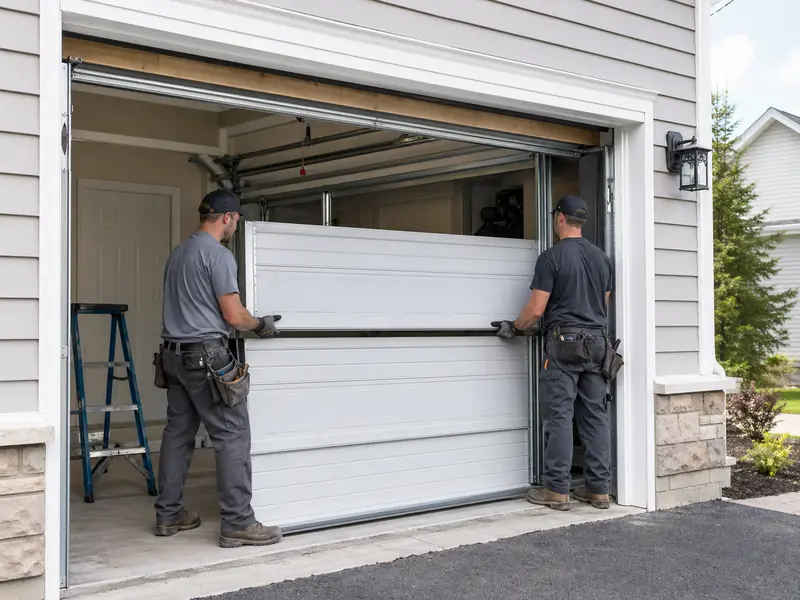
GarageGuard’s installation process includes measuring the opening, confirming door and opener compatibility, removing the old door and worn hardware, setting the new track and sections, installing matched lift hardware, balancing the door, reconnecting or installing the opener, programming controls, and testing the door through multiple open-close cycles.
Opener and smart-control setup
A replacement door is often the right moment to upgrade the opener, especially if the current unit is loud, missing safety features, unreliable, or not compatible with the new door weight. We can install or reconnect compatible LiftMaster, Chamberlain, Genie, and other major opener systems, including belt-drive, chain-drive, wall-mount, battery-backup, keypad, remote, HomeLink, and smart-app setups.
Before we leave, the door should reverse safely, seal evenly, respond to the controls you use, and move without the opener straining.
Service area for installation work
GarageGuard installs replacement garage doors throughout Nassau County, Suffolk County, Queens, Brooklyn, Staten Island, Westchester, Northern New Jersey, and Fairfield County CT. If you are comparing repair vs. replacement, tell us the door size, material, visible damage, opener behavior, and whether the garage is attached to the home. That helps us bring the right installation or repair recommendation to the first conversation.
Related services
- If one damaged section can be matched, see garage door panel replacement.
- If the door is heavy but structurally sound, see garage door spring repair.
- If the motor is the weak point, see garage door opener repair.
- If the door is crooked or stuck after impact, see off-track garage door repair.
- For urgent unsafe-door situations, see emergency garage door repair.